1. Thermal Imaging
  2. Applications
  3. Thermography in the Photovoltaic Industry

Thermography in the Photovoltaic Industry

Thermography can make an important contribution to the development and manufacture of solar cells and modules, as well as to the inspection of solar systems. This testing method is employed to

  • Efficiently detect performance losses in cells and modules

  • Identify defective cells and modules

  • Analyze solar cells of all types (TOPCon, Heterojunction, PERC, BC, etc.) in a contactless and non-destructive manner

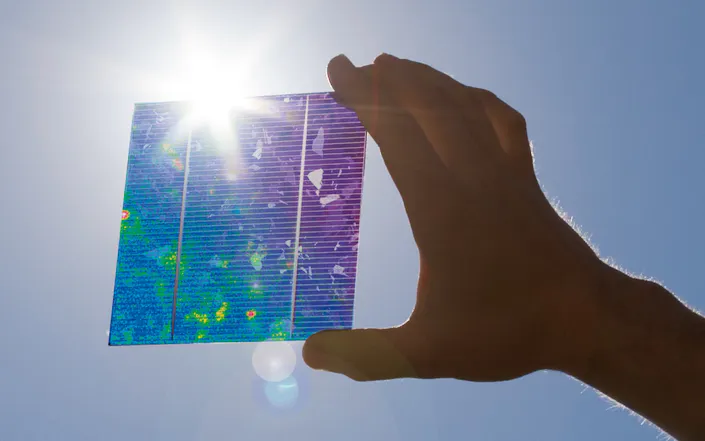
Increasing the efficiency of solar cells is one of the key priorities in photovoltaic research. Recent developments have led to increasingly complex, multi-layer cell structures. Active thermography enables non-destructive testing of individual solar cell layers and the detection of faults through hot spots.

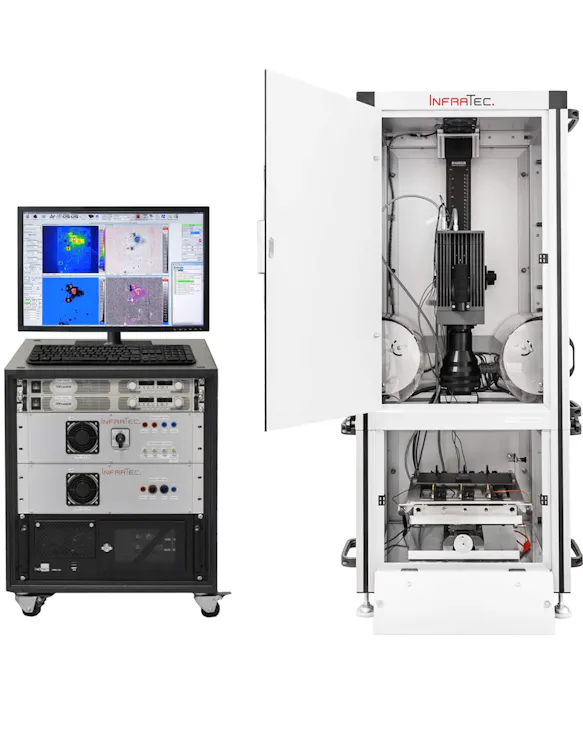
Automated testing system PV-LIT
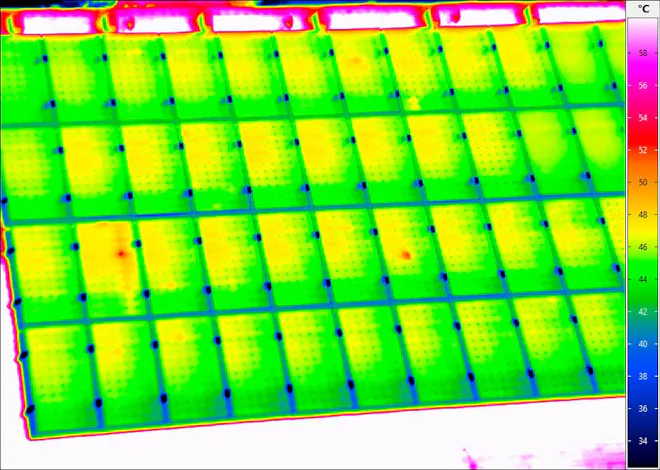
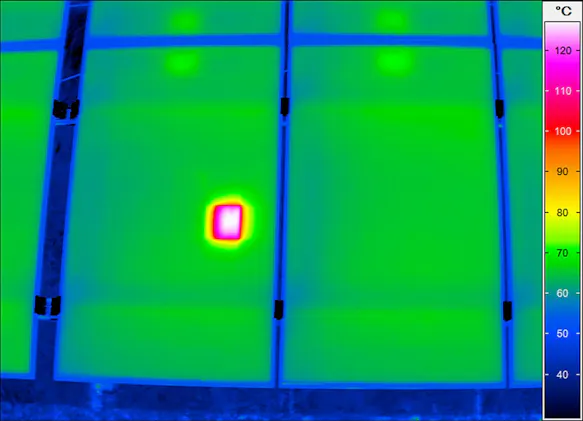
Thermal image of an photovoltaic plant
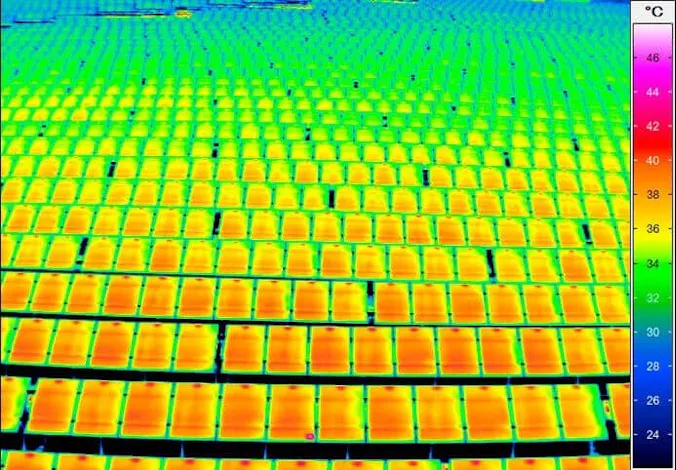
thermal imaging of a photovoltaic large scale plant
0 | 3

Lock-in Thermography on Solar Cells

Passive thermography – a reliable and established method for functional testing and characterization of large solar modules – quickly reaches its limits when it comes to continuous production monitoring and solar cell research and development. However, Lock-in Thermography combined with high-performance infrared cameras can detect temperature differences in the microkelvin range. These local heating effects are caused by cell defects during contactless (Light Modulated Lock-in Thermography, LimoLIT) or contact-based (Voltage-modulated Lock-in Thermography, VomoLIT) periodic excitation of the test object.

The so-called leakage current plays a decisive role in efficiency and thus the overall performance of a solar cell. This loss current, which negatively affects the efficiency of the solar cell, is mainly caused by thermally excited charge carriers in the semiconductor material that diffuse across the space charge zone of the pn junction diode – opposite to the direction of the photocurrent.

Causes of high leakage currents include for example material defects, impurities, and surface or edge defects. Passivation defects, which play a particularly important role in PERC solar cells (Passivated Emitter and Rear Cell), are also associated with increased leakage currents.

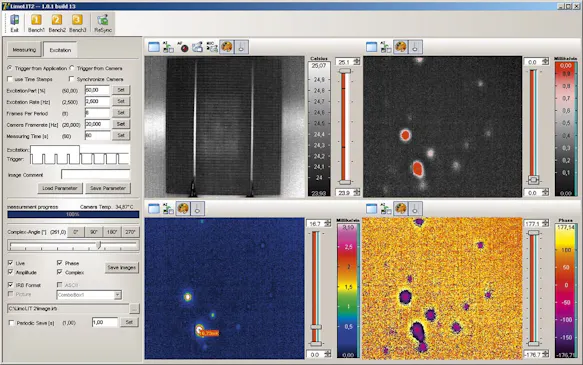
PV-LIT Control software

Thermographic analyses of solar cells have shown that leakage currents are practically never homogeneous across the entire surface of the cell. There are areas with low leakage currents and areas where they are locally increased, often by a factor of 10 to 1,000. These areas with high leakage currents are referred to as shunts. Lock-in Thermography allows the detection and quantitative evaluation of such shunts in solar cells.

The deployed thermography software is key to detecting these defects. It allows important test parameters such as excitation and recording frequency or excitation amplitude to be set and also enables evaluation using various active thermal imaging algorithms, comparison of measurement data, and storage of results. The information obtained helps to locate the corresponding defects and narrow down the causes of performance losses.

Benefits of Lock-in Thermography for Quality Analysis of Solar Cells and Modules

PV-LIT laboratory system
  • Reliable defect detection (shunts), for example, detection of leakage currents in solar cells and modules using Lock-in Thermography

  • Analysis of test objects with structures down to a few micrometers (µm) in size and a thermal resolution in the microkelvin range

  • Detection and precise localization of even weak local shunts by reducing the influence of lateral heat spread (silicon is a good heat conductor)

For detailed analysis of solar cells, InfraTec offers the automated thermographic system PV-LIT, which can be used for all types and formats of solar cells and modules. Excitation is carried out electrically or contactlessly with light.

Asso­ci­ated Ther­mo­graphic System Solu­tions

PV-LIT test solution for solar cells
Non-destructive Testing

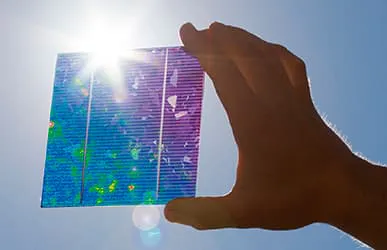
Photovoltaic Test System – PV-LIT

Get advantages in costing and quality by non-contact thermographic testing of your solar cells and PV-modules.

Solar Power Tower Check - Picture credits: © iStock.com / paulrommer
Indus­trial Auto­ma­tion

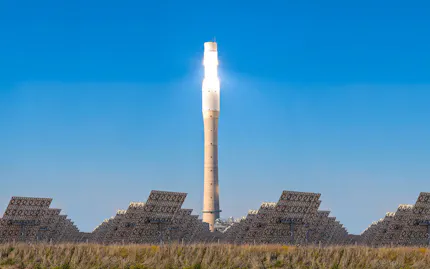
Solar Power Tower Check - SPTC

Solar tower power plants belong to the category of solar-thermal power plants whose basic principle relies on the absorption of direct radiation from the sun and its conversion into thermal energy.

Thermographic Automation Solutions - Automatic object monitoring system IROD
Early Fire Detection & Observation

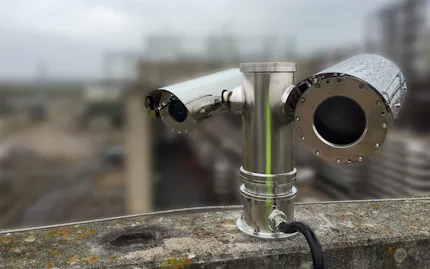
Site Surveillance – IROD

Calibrated measuring cameras offer the option of a completely automated site surveillance by utilising temperature alarms – an approach well beyond the simple and susceptible motion detection systems used elsewhere. With IROD InfraTec offers a scaleable, powerful system solution.

PV-LIT test solution for solar cells
Non-destructive Testing

Photovoltaic Test System – PV-LIT

Get advantages in costing and quality by non-contact thermographic testing of your solar cells and PV-modules.

Solar Power Tower Check - Picture credits: © iStock.com / paulrommer
Indus­trial Auto­ma­tion

Solar Power Tower Check - SPTC

Solar tower power plants belong to the category of solar-thermal power plants whose basic principle relies on the absorption of direct radiation from the sun and its conversion into thermal energy.

Thermographic Automation Solutions - Automatic object monitoring system IROD
Early Fire Detection & Observation

Site Surveillance – IROD

Calibrated measuring cameras offer the option of a completely automated site surveillance by utilising temperature alarms – an approach well beyond the simple and susceptible motion detection systems used elsewhere. With IROD InfraTec offers a scaleable, powerful system solution.

Thermography for Inspecting Photovoltaic Systems

In addition to analyzing individual solar cells, thermal imaging can also be used to inspect entire PV systems. In addition to conducting analyses of individual solar cells, thermography can also be used to inspect entire PV systems. To examine these systems comprehensively for hot spots, mobile devices are usually required. In the building sector, simple infrared cameras with correspondingly low thermal resolution are typically used for small and medium-sized photovoltaic systems. In solar parks, however, it is also useful to install high-quality infrared cameras on drones or helicopters and inspect the module surfaces during aerial surveys.

Learn more about Aerial Thermography

Regular monitoring is definitely advisable: As with all technical equipment, photovoltaic systems are subject to aging, which usually manifests itself in the form of hot spots. These significantly warmer areas in the module or in individual solar cells are often caused by mechanical damage (for example, cracks in the conductor tracks) or delamination processes, in which the solid bond between the solar cells and the encapsulation breaks down. The defective areas act as ohmic resistances. When the current produced by the neighboring cells flows through them, the electrical energy is converted into heat. Thermal imaging can be used to measure the resulting temperature increases.

Photovoltaic thermal imaging shows cell failures

Publications of our Customers

Physikalisches Modell zur ther­mo­grafis­chen Verlust­bestim­mung an defekten PV-Modulen, Bernhard Weinreich et al., Solarschmiede GmbH

Lock-in Ther­mo­graphy for analy­zing solar cells and failure analysis in other elec­tronic compo­n­ents, Otwin Breitenstein, Steffen Sturm, Max Planck Institute Halle

Thermography Automation System: PV-LIT

An empirical method for imaging the short circuit current density in silicon solar cells based on dark lock-in thermography, Otwin Breitenstein et al.

Physikalisches Modell zur ther­mo­grafis­chen Verlust­bestim­mung an defekten PV-Modulen, Bernhard Weinreich et al., Solarschmiede GmbH

Lock-in Ther­mo­graphy for analy­zing solar cells and failure analysis in other elec­tronic compo­n­ents, Otwin Breitenstein, Steffen Sturm, Max Planck Institute Halle

Thermography Automation System: PV-LIT

An empirical method for imaging the short circuit current density in silicon solar cells based on dark lock-in thermography, Otwin Breitenstein et al.

Contact to thermography division of InfraTec

Would You Like to Know More?

It is not unusual for tasks to be associated with special requirements. Discuss your specific application needs with our specialists, receive further technical information or learn more about our additional services.

United States
InfraTec infrared LLC1900 West Loop South Suite 155077027 HoustonUNITED STATES

Advant­ages of this Ther­mo­graphy Solu­tions in this Applic­a­tion

MicroScan feature ImageIR

Micro­Scan – Quad­ruple the Image Format

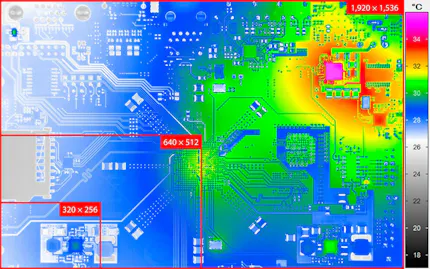
Behind the function is a fast-rotating MicroScan wheel, which is integrated into the camera. It ensures that four different individual exposures are taken per wheel revolution, which are offset laterally by half a pixel each. In this way, thermography achieves a new quality due to thermal images providing a quadrupled spatial resolution.

InfraTec glossary about motor focus

Motor Focus

Remote-controlled Focussing of the Thermal Image

Interchangeable standard lenses in the ImageIR® series can be equipped with a motor focus unit. This enables precise, remote-controlled and fast focussing via the operating software.

infrared camera VarioCAM HD head of InfraTec

High-quality Light Metal Housing

Robust, lightweight metal housings with IP67-rated protection shield cameras from mechanical and thermal stress. In combination with LEMO® connectors, which preserve this protection rating, they are ideal for harsh industrial environments. For extreme conditions, protective housings, for example those made of stainless steel, are optionally available with cooling and heating.

InfraTec thermography - Geometrical Resolution

Geometrical Resolution

Reliable Detection

InfraTec infrared cameras offer high geometrical resolution, enabling detailed thermograms for reliable defect detection and precise localisation.

Trigger interface for ImageIR® and TarisIR® cameras

Trigger Interface

Interface for Incoming and Outgoing Control Signals
Trigger signals to or from the camera can be used to control and synchronise image data acquisition. Thermographic measurements can also be used to control processes.

MicroScan feature ImageIR

Micro­Scan – Quad­ruple the Image Format

Behind the function is a fast-rotating MicroScan wheel, which is integrated into the camera. It ensures that four different individual exposures are taken per wheel revolution, which are offset laterally by half a pixel each. In this way, thermography achieves a new quality due to thermal images providing a quadrupled spatial resolution.

InfraTec glossary about motor focus

Motor Focus

Remote-controlled Focussing of the Thermal Image

Interchangeable standard lenses in the ImageIR® series can be equipped with a motor focus unit. This enables precise, remote-controlled and fast focussing via the operating software.

infrared camera VarioCAM HD head of InfraTec

High-quality Light Metal Housing

Robust, lightweight metal housings with IP67-rated protection shield cameras from mechanical and thermal stress. In combination with LEMO® connectors, which preserve this protection rating, they are ideal for harsh industrial environments. For extreme conditions, protective housings, for example those made of stainless steel, are optionally available with cooling and heating.

InfraTec thermography - Geometrical Resolution

Geometrical Resolution

Reliable Detection

InfraTec infrared cameras offer high geometrical resolution, enabling detailed thermograms for reliable defect detection and precise localisation.

Trigger interface for ImageIR® and TarisIR® cameras

Trigger Interface

Interface for Incoming and Outgoing Control Signals
Trigger signals to or from the camera can be used to control and synchronise image data acquisition. Thermographic measurements can also be used to control processes.

Asso­ci­ated Indus­tries & Applic­a­tions

thermal imaging in glass industry

Glass Industry

Measure correctly temperature distributions behind and on glass by using selected spectral filters.

All branches and application areas