Emissivity and Automatic Pixel-by-Pixel Emissivity Correction
Emissivity is a key parameter for accurately determining temperatures using thermography. Real surfaces generally do not behave like an ideal black body. Correction methods are necessary, particularly for complex objects made of different materials or featuring different surface textures, in order to obtain precise and reproducible temperature values.


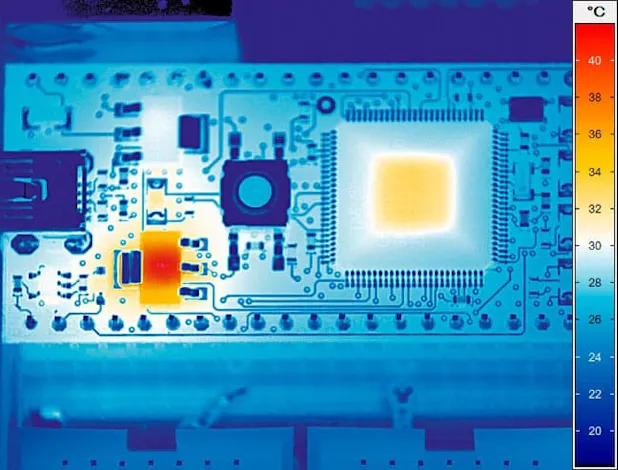
What Is Emissivity?
The emissivity (ε) of an object indicates how much radiation it emits compared to an ideal thermal emitter. This model body, which is based on the principles of radiation physics and is also known as a “black body,” has the maximum possible emissivity of ε = 1 (equivalent to 100%), and is independent of wavelength.
The emissivity of real test objects (0 < ε < 1) depends on the following parameters:
Material composition
Surface condition (for example, roughness, oxidation or contamination)
Measurement angle [ε = f(a)]
Temperature [ε = f(T)]
Measurement wavelength [ε = f(λ)]
In addition to an incorrectly set emissivity, the “reflected temperature” – that is, the portion of radiation reflected from the surroundings – can cause measurement errors.
When Is Emission Correction Necessary or Recommended?


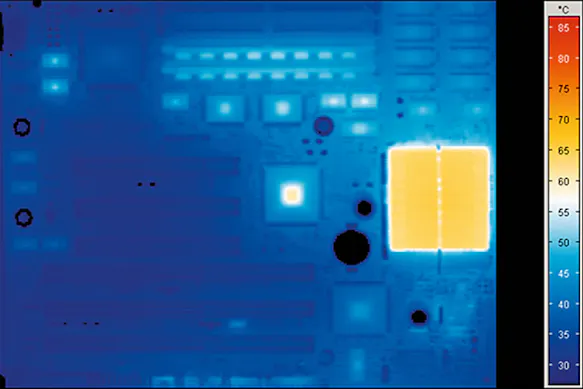

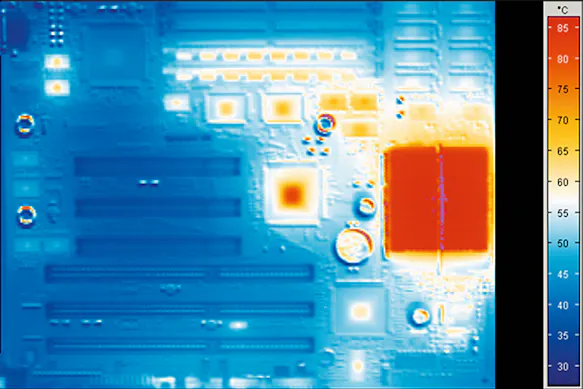
To correctly determine the temperature of a surface, the thermal radiation measured with thermal imaging must always be corrected for the corresponding emissivity. This task becomes challenging when the surfaces of objects whose temperature is to be determined exhibit varying emissivities across their surface.
If no emissivity correction is applied to these complex objects, an average value is typically used. In this case, local deviations from the set emissivity result in additional local measurement errors or temperature differences with positive or negative signs.
Lateral variations in emissivity occur whenever a test object consists of multiple components or sub-areas with different surface textures or made of different materials. To obtain accurate measurements in such cases, correction models built into the thermography software may be used.
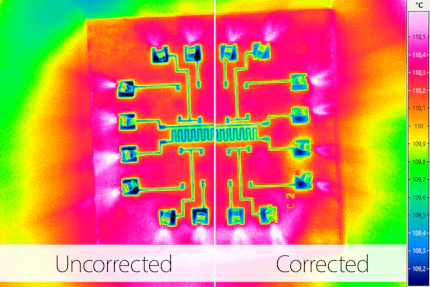
For this purpose, various regions of any shape are defined on the test object, and the corresponding emissivities and ambient radiation temperatures are assigned to them. If these defined regions are very small – for example, in measurements on printed circuit boards – the manual definition of the correction areas in the thermogram becomes very labor-intensive.
The solution to this problem is provided by the tool for automatic pixel-by-pixel emissivity correction. InfraTec’s IRBIS® professional thermography software calculates a custom emissivity value for each individual image pixel.
What Methods Are Available for Pixel-by-Pixel Emissivity Correction?
The Thermography software IRBIS® offers users various methods for pixel-by-pixel emissivity correction, the practical application of which is described in detail in the software manual. All methods require the creation of at least one reference image, which is used to calculate the correction parameters.
Direct Pixel Correction
Direct pixel correction is used when the object can be heated to a uniform temperature (T
Prerequisite: The ambient temperature differs significantly from the object temperature: T
Indirect Pixel Correction
Indirect pixel correction is used when the temperature of the object cannot be adjusted for the reference measurement. Instead, the ambient temperature (T
Prerequisite: The ambient temperature differs significantly from the object temperature: T
Direct Pixel Correction Using Two Reference Images
This method is suitable when the object can be heated to a homogeneous temperature (T
Prerequisite: Both object temperatures must differ from the ambient temperature: T1
Indirect pixel correction using two reference images
This method of pixel correction is used when the object cannot be temperature-controlled or its temperature is unknown. Two reference images are captured at different ambient temperatures (T1
Prerequisite: Both ambient temperatures must differ from the object temperature: T1
Note on Object Positioning
For all listed models of automatic pixel-by-pixel emissivity correction, it is important that the relative positions between the camera and the test object remain unchanged when capturing the reference images and during the measurements. This means that the object must always be positioned relative to the camera with pixel-level precision and in a reproducible manner.