


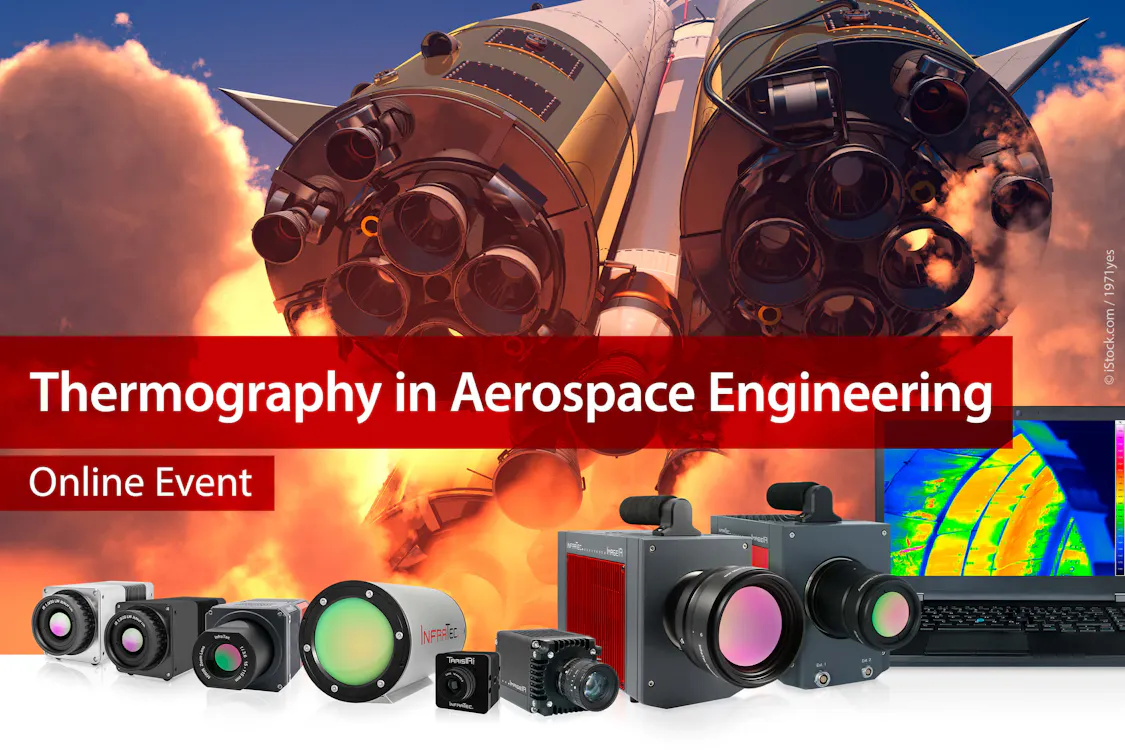
Online Event: Thermography in Aerospace Engineering
In our free InfraTec online event “Thermography in Aerospace Engineering”, you will learn more about the wide range of possible applications of thermography for research and development in aerospace engineering and for the investigation of friction processes. Our experts will demonstrate how temperature distributions and their temporal trends can be captured, analyzed and used for effective testing.
Online Event “Thermography in Aerospace Engineering”
Date: Wednesday, September 23, 2026
Time: 10:00 AM – 12:00 PM (CEST)
Language: English
Price: free of charge
Register now for our online event
Every object sent into the atmosphere and beyond must first be tested for stability and functionality. Thermography offers a wide range of possibilities for analyzing how materials and components behave under the demanding conditions of flight or in space. Contactless, two-dimensional temperature measurement enables, for example, the localization of material defects under mechanical stress or hot spots on electronic components during actual operation, the analysis of flow processes on airfoils or turbines, and the evaluation of the heat resistance of ceramic materials.
Thermography can provide answers to a wide range of questions in aerospace engineering. However, the broad spectrum of associated measurement and testing tasks requires thermal imaging cameras of various performance classes, appropriate measurement methods, and specific expertise to achieve optimal results. Cameras designed for spectral thermography, for example, can be used in engine development, for the detection of combustion gases, or for the development and investigation of special ceramic coatings.
Active thermography offers numerous possibilities for non-destructive testing, ranging from fundamental investigations of asteroid samples returned to Earth by space probes to quality control of fiber-reinforced materials. With the help of micro thermography, thermal microactuators for nanotechnology can be analyzed, and electronic components can be optimized with regard to their thermal management.
High-speed thermography enables even the fastest processes to be captured in detail, such as the thermal stress on the outer skin of missiles during re-entry into the atmosphere or on braking systems during aircraft landing.
In the online event, our experts will explain in detail the capabilities of innovative thermography cameras for investigating the many different questions in aerospace engineering. Our guest speaker from industry will also provide you with in-depth insights into practical applications. He will share how thermography is used in his work, the specific challenges he has faced, and how he has mastered them.
𝗔 𝗚𝗹𝗮𝗻𝗰𝗲 𝗮𝘁 𝘁𝗵𝗲 𝗘𝘃𝗲𝗻𝘁
Applications of thermography in aerospace engineering, from electronics testing to materials testing
Analysis of defects, hotspots, flow processes, and thermal stresses under real-world conditions
Overview of various methods, including spectral, active, micro, and high-speed thermography
Selection of suitable thermal imaging cameras and methods for specific measurement tasks
Practical insights from experts and a guest speaker from industry, featuring concrete application examples